
Do we really have growth in the economy?
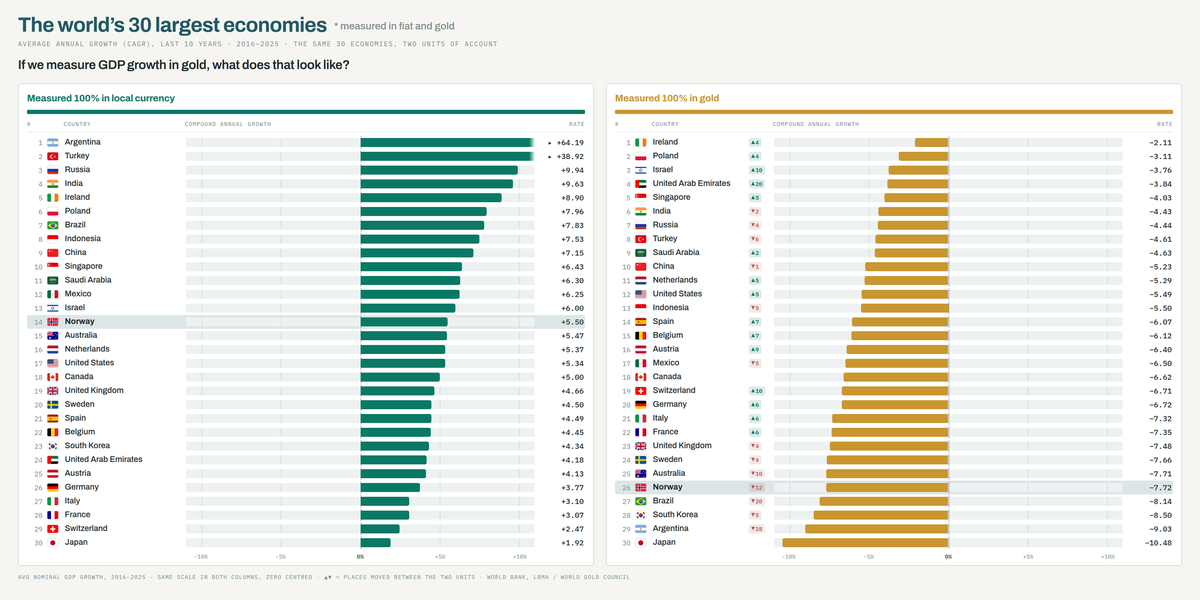
Measured in fiat, all 30 of the world's largest economies grew over the past decade. Measured in gold, every single one shrank. Gold compounded at 11.5% a year while official inflation ran at 3.2-3.3%. What's the fairest way to measure real economic growth? See TÝR Markets' morgenrapport.
TÝR Markets: en norsk kryptoplafftorm med MiCA-tillatelse fra Finanstilsynet og Norges laveste transaksjonskostnader
Is it just me, or does your purchasing power feel weaker than it did ten years ago?
Measured in fiat, everything looks fine. All 30 of the world's largest economies grew over the last decade. But is that an accurate measure of growth, or just of the unit we happen to be counting in?
Look at the ranking in local currency (nominal values). The countries at the top are not the ones you would point to as healthy economies. Argentina leads at +64% annual growth. Turkey follows at +39%. That isn't economic output, that's inflation showing up in the numbers.
Now measure the same GDP growth in gold. The list reorders completely, and all 30 economies have negative growth. The problem with fiat is that it's a relative game. Each currency is measured against its own inflation, and against every other currency. It isn't a neutral indicator of how an economy is actually doing, and it is certainly not a good tool if you want to do a cross-country comparison. And yes, we know that in many cases we economists use the USD, but what if the USD is inflated as well? That's why we have ended up using gold as a measuring tool.
Gold compounded at 11.5% a year over this decade. Official inflation ran at 3.3% in Norway and 3.2% in the US. We would argue the gold price is closer to the true rate of monetary debasement than the number that gets reported.
We know not everyone will agree with using gold as the yardstick. But ask yourself, what is gold actually used for?
Only 6% of gold demand in 2025 was industrial. The rest is jewelry, bars, coins, ETFs and central banks, bought because it holds value, not because it does anything. That is precisely the critique people level at Bitcoin: no use case beyond store of value. Gold has been answering to that critique for five thousand years.
Full disclaimer: this is a simplification. The local-currency figures are nominal, inflation included, but it has to be that way if we are to compare them to gold prices which also include inflation. Gold prices are annual averages throughout, not year-end prices: the LBMA average went from $1,160 an ounce in 2015 to $3,431 in 2025.
What do you think is the fairest way to measure economic growth?
Data: World Bank · LBMA / World Gold Council · Annual averages, 2016–2025
Les morgenrapporten under!

En norsk kryptoplafftorm med MiCA-tillatelse fra Finanstilsynet og Norges laveste transaksjonskostnader
Comments ()